Thursday, November 20, 2008
Twelve Things I Know
Monday, November 3, 2008
Rick Mountain and Cottonwood Gulch
Tonight I took a closer look at the plat map and Ernest's land description. I realized the land the clerk had marked in the assessor's office was only 40 acres--the 40 acres I paid attention to when we visited the Rick Mountain Ranch. However, according to the deed, Ernest owned 160 acres.
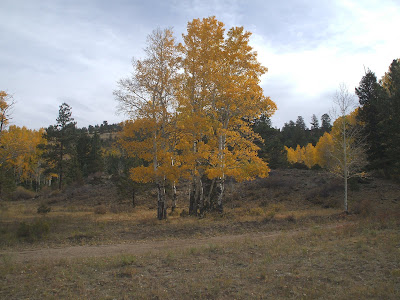
The earlier pictures I posted are the 40 acres on the east side. The Rick Mountain and Cottonwood Gulch pictures above show the 120 acres to the west. This land is six miles up Cottonwood Gulch out of Salida.
Wednesday, October 29, 2008
Women Writing The West Conference
Tuesday, October 7, 2008
Ernest Christison's Land
Thursday, September 25, 2008
What Is History?
On Monday, I opened the newspaper and saw that one of my high school history teachers, Robert Lowenberg, would be giving a program at Castle Rock on Wednesday. I knew I couldn’t miss this!
When I was a senior in 1983 at the Douglas County High School in Castle Rock, Colorado, I was selected to be in a small class called “What Is History” taught by Mr. Lowenberg. Mr. Lowenberg had a passion for preserving the historic structures in Castle Rock and recording their history. Mr. Lowenberg’s goals for the class were 1) to learn the skills and methods of an historian and 2) to do primary research, using written, physical and human resources within the community. Mr. Lowenberg spent the first five weeks exploring what history means and how we define it. Next, he divided the class into teams of two students and assigned each team a house in Castle Rock to research. Kathy Kirby and I were assigned the Memmen house, a small farm on the outskirts of Castle Rock (now surrounded by the town). Mr. Lowenberg drove us to the library, newspaper office, or courthouse each class period teaching us how to search old newspapers and census records, how to use grantee/grantor records for title searches, and how to interview the people who lived in the house and those who knew something about the house. Kathy and I discovered the house was once owned by John H. Craig, one of the founders of the town of Castle Rock. Two mayors of Castle Rock had also lived in the house.
Kathy and I wrote our term paper for the class and each included our impressions on “What Is History?” After attending Mr. Lowenberg’s program last night, I pulled out my old paper. How interesting to look back and see what I had learned and what I had to say about history. I used a quote by Carl L. Becker who said, “History is the memory of things said and done.” I wrote, “Memory is not always accurate even if it is written down.” That is something I really believe now! I also wrote, “Complications make the work hard, but they do not overpower the rewards.”
As to my expectations of how history and this class would affect my life, I wrote, “I believe I would like to be a historian, but it will probably just be a hobby. This class has been the best class I have ever had. I lived and breathed this class. It was so hard to come back from Castle Rock after reading about the people and town and try to concentrate on Chemistry [class]. I will always be able to use the skills I learned in this class. History is more than just the past to me now; it is the present.”
Twenty-five years have passed since I was in Mr. Lowenberg’s “What Is History?” class. I haven’t seen Mr. Lowenberg since I graduated from high school. Last night I introduced myself to him and he said, “Yes, I remember you!” I think that’s pretty good since there were over 400 students in my graduating class alone. I was happy to tell him I am still using the research skills and understanding of history I gained in his class.
Bob Lowenberg gave a presentation on “Getting To Know Castle Rock.” He also sold and signed copies of a book he put together in 1981 called Castle Rock: A Grass Roots History using the papers students wrote in his earlier classes.
It isn't often we have a chance to thank the person from the past who made a huge impact on our lives. I want to thank Mr. Lowenberg for his passion for history and for his joy in passing along what he had learned. That combination makes the best kind of teacher. And Mr. Lowenberg is one of the best. Thank you, Mr. Lowenberg.
Wednesday, July 30, 2008
Lynn Monroy, Graphologist
Those of you who have followed my journey in researching and writing about my family know that unexpected surprises are becoming common for me. Never knowing what will turn up next or who I will meet is an adventure that I love! Another opportunity opened through a member of Women Writing The West and I decided to pursue it to see what happens. Author Eunice Boeve wrote an e-mail to the WWW group about her cruise to Alaska. For Eunice, one of the exciting parts of the cruise was a daily program about Wyatt Earp and Doc Holliday and other men involved in the shoot-out at the OK Corral in Tombstone given by graphologist Lynn Monroy. Lynn had studied and analyzed the handwriting of the men on both sides of the conflict and gave an entertaining and enlightening program by showing examples of their handwriting and giving insight into their character. Lynn also chose three people randomly each day to analyze their handwriting and Eunice was one that was chosen. She thought Lynn's findings about her were fairly accurate. Lynn even pegged her as a writer!
After reading Eunice's e-mail, I decided to contact Lynn about my project. Lynn expressed her interest and said she would be in Colorado and perhaps we could meet. Yesterday we met at the Colorado State Archives so Lynn could look at the original letters and documents. I showed her a note that is signed by both Ernest Christison and Ed Watkins and a note that isn't signed but has the name of Watkins' ranch on it. I had hoped that maybe the note signed by both men was written by Ernest, but Lynn thought it was most likely written by the Justice of Peace or court clerk since it had seal on it. But she was fairly certain the note from Watkins' ranch was probably written by Watkins. She could tell that he was an educated man by the handwriting. I know he did go to college and was active in the literary society in Salida.
Lynn made copies of the notes and several other papers. She thought one of the lawyers must have been quite a character from his handwriting. Then I remembered finding a court case last for which Wilburn Christison was the county judge, so we looked in the file to see if we could find a document he had written. We found one! So Lynn had it copied, too, and will analyze it. I can't wait to learn what she discovers in the handwriting of all of these men. I also hope I can find a sample of Ernest's handwriting--even a signature would help.
Thank you, Lynn! This is exciting!
Lynn's sister, Renee, took the picture of Lynn and I in front of the prison record exhibit at the archives before they left for the airport. Thanks, Renee, for driving Lynn to meet with me!
And thank you, Eunice, for getting me in contact with Lynn! I appreciate all of my friends in Women Writing The West.