Showing posts with label Ernest Christison. Show all posts

Monday, June 29, 2020

Learning the Craft of Writing Fiction


My first view of Virgil Ernest Christison's Rick Mountain Ranch in 2008.

It’s been a while since I’ve blogged about writing the cattle rustling book. I started writing the book in 2007. Over the years, I’ve shared the changes on this blog – nonfiction to creative nonfiction to historical fiction.

I began writing the book as historical fiction on July 7, 2011. Yes, nine years ago. Friends and family have a hard time understanding why the book isn’t written by now. The reason? Writing historical fiction is hard. And it is a process. The facts and events had to become STORY. The people had to become characters, characters with emotion and motives.
The book I am writing now is very different from the book I was writing nine years ago. I am glad I didn’t rush it. And happy I didn’t give up.

Last November, I joined five other writers in a workshop series with Page Lambert at Mount Vernon Club in the mountains west of Denver. We met monthly for five months. COVID-19 hit in the middle of this. We had one meeting by Zoom and had our final workshop yesterday.

When I started the workshop, I thought I’d start at point A and be well on my way with a finished book by the end. Yes, my perfectionist tendencies kicked in. Instead, I shared chapter one at the first workshop, but Page suggested starting with an earlier event mentioned in the chapter. So, by the next workshop I had another chapter one. And this repeated two more workshops. I now have four new chapter ones, but really they are the first four chapters of my book.

Working backwards was not my intention when I started the workshop. But by working backwards, I gained a better understanding of the story. Events I thought I could summarize became their own scenes. And by settling into the story, new motives came to light. I now have a good, solid beginning for the book with an inciting incident that puts into motion all of the events of the story.

Page Lambert taught me how to write fiction. I’ve always been able write action scenes that gallop along. What I am not so good at is writing description and inner dialogue. Page’s workshops helped me learn how to do that with input from the other writers. I have also learned I can take a messy draft and reorganize and rewrite it. One of my biggest fears. Mostly, I have learned to trust myself as a writer. I have good instincts. I have good intuition. And, I am a good writer. Today I am reveling in this knowledge. It feels good.

My advice to those writing a book – don’t give up. Learn your craft and never, ever read your writing when you are emotionally tired.

Below are blog posts I've written about my journey of writing this book:


Research is Done! It's Time to Write!  (And yes, I have to laugh about this 2009 post. Still finding new information 11 years later!)


Switching from Nonfiction to Fiction

Circling and Story Round-Up

Part 2 Circling and Story Round-Up 

Step Into The River

Wednesday, September 18, 2019

The Fairplay Jail


If you know about the song I wrote, "Freedom in January," then you know the story of Ernest Christison breaking out of the Buena Vista jail with eleven other prisoners. But the Fairplay jail also plays a prominent part in the cattle rustling story.

Ernest Christison was arrested by a group of South Park cattlemen at St. Elmo on the 6th of July in 1883. The cattlemen also arrested four others: Charlie Christison (Ernest's 14-year-old brother), Billy Taylor (Ernest's 21-year-old brother-in-law), John Taylor (Ernest's father-in-law) and John Meyer (who rode along with John Taylor when he delivered supplies). The cattlemen took their prisoners on a 3-day ride across South Park to Rocky, where a justice of peace bound the men over for trial. Then they were incarcerated in the Fairplay Jail. 


To make things even more interesting, Ernest and Charlie's father, Wilburn Christison, was the Park County Judge from 1872 until he died in 1882, the year before Ernest and the others were arrested. Ernest and Charlie spent time in their father's jail.


Gayle Gresham, Laura Van Dusen, and Christie Wright

I visited the Fairplay Jail behind the old Fairplay Courthouse today with two Park County authors, Christie Wright (South Park Perils) and Laura Van Dusen (Parked in the Past). Christie arranged for us to go into the jail, which isn't open to the public, with Jennie Andrusin, the Park County Project and Grants Manager. 


There are two tiny cells in the jail, with places for 4 bunks in each. There would hardly be room to walk between the bunks if there were two on the other side.


Apparently, Buena Vista wasn't Christison's first attempt at a jail break. On March 18, 1884, a Fairplay prisoner broke out of jail using a small saw that Ernest Christison had used to saw away at one of the bars. While Christison was unsuccessful, Byard cut away a 10" x 16" hole to crawl through and escape. Byard also sawed under the cover of a fiddler who played every night after supper. (This story is told on page 55 of Christie Wright's book, South Park Perils.)

Sunday, May 6, 2018

The Redemption of Ernest Christison Article in the Mountain Mail

Virgil Ernest Christison's grave marker in the Fairview Cemetery, Colorado Springs
I've been enjoying the articles written by Joy Jackson, archivist at the Salida Regional Library, about Salida stories of the past in her column, "At the Library." My friend, Margy, sent me copies of the four-part Cattle Thieves series published from November 2017 to February 2018 in the Mountain Mail. And a couple of other friends sent me links to the articles. 

The final article is "The Redemption of Ernest Christison." It is fun to see my great-great-uncle, Ernest, have his own headline and article. Jackson refers to newspaper articles from 1883-1884 which I have also used extensively in my research. It is interesting to read someone else's conclusions. 


I thought I would fill in a little family history information. Virgil Ernest Christison was the second oldest son of Judge Wilburn and Elizabeth Christison. In 1879, he married Nancy Jane Taylor. Their first child, John, was born in 1882. Their daughter, Grace, was born in August of 1883 before Ernest went to jail in Buena Vista.

Ernest was sentenced to two years in the Colorado State Penitentiary and was released two months early for good behavior in March of 1886. Ernest and Nancy had two more daughters, then two more sons (the first Roy, born in 1893, probably the baby mentioned in the article) and finally, a daughter, Helen, born in 1904.


Ernest died in 1939 in Colorado Springs. His obituary reads in part, "Virgil E. Christison, 86, who came to Colorado as a youth and engaged in the mining and freighting business shortly after the Civil War, died yesterday at the residence of a daughter, Helen." 

Saturday, July 26, 2014

National Day of the Cowboy


Ernest Christison (Drawing by Katy Kinder from a photograph)
Today, July 26, is National Day of the Cowboy. I thought it an appropriate time to share this drawing of Ernest Christison with his horse and his dog. He doesn't look like much of an outlaw, does he? Artist Katy Kinder drew this from a photograph in which the horse was blurry and faded. The photo was likely taken in the late 1870's or early 1880's.

Born in Missouri in 1852, Ernest traveled west with his family to the Colorado mining camp of Cash Creek when he was 9 years old. His older brother, Leslie, followed his father into mining, but Ernest preferred horses and cows to picks and rocks.

His first brand was recorded in 1876, the same year he signed on to round up 175 head of cattle for the ranchers Leonhardy and Turkey and trail them from Buena Vista to Denver to sell. The cowboys arrived on April 23 and they held the cattle at a ranch near Denver until the sale could be made. Everything seemed to be going well until a spring blizzard blew in at noon on April 25 and stampeded the cattle. Two days and four feet of snow later, the cowboys proceeded to locate and round up the scattered cattle. Ernest became snow blind which made it impossible for him to continue with the round-up, but Henry Weber managed to locate the rest of 155 head of cattle, sold them, and returned to the Buena Vista with Ernest.

Ernest had a couple of cattle partnerships including one with Thomas Cameron and his son, J.B., before his partnership with Ed Watkins.

If you want to read more about the outlaw part of this story, click on The Cattle Rustling Story.

Monday, November 4, 2013

Freedom in January

Barry Ward recently released his new CD, Lonesome County Road. John and I are especially honored that Barry recorded the song we wrote, "Freedom in January." The song is a little bluegrass number telling the story of Ernest Christison's (my great-great-uncle) jail break in Buena Vista, Colorado in 1883.

Former Flying W Wrangler Joe Stephenson added the perfect fiddle part to the song for my fiddle-playing outlaw. And Ernie Martinez, nominated for the 2013 Instrumentalist of the Year by the Western Music Association, played the dobro, intoning a lonesome train whistle on the break.


"Freedom in January" tells the story of Ernest Christison who, along with ten other prisoners, knocked out a hole in the brick wall and "broke jail." The jail is now the school administration offices. At the back of the building, you can still see where the bricks were replaced.


The Buena Vista Democrat (http://ColoradoHistoricNewspapers.org)

Ernest Christison and Albert Sweeny ran half a mile to the Arkansas River. This photo was taken 126 years later on the anniversary of the jail break. Fortunately for the men, there wasn't snow on the ground so they couldn't be tracked. They crossed the river and hid on the hill a while, and then started walking south to Salida. They crossed the river again near Nathrop. Thinking of the men walking through the freezing cold water prompted the line, "Freedom in January is worth the frost."
Ernest and Albert made it to Thomas Cameron's home just north of Salida, where they found food, a Winchester, and a place to sleep. But Cameron's was being watched and the men were rudely awakened by "a shotgun barreled side by side" shoved in their faces. After they were captured, the men returned to Buena Vista on the train with an armed guard.


Lonesome County Road is available for order at http://BarryWardMusic.com/new-cd/  Be sure to check out Barry's schedule and see him in concert when he is in your area
. 

Thursday, July 7, 2011

Switching From Nonfiction to Fiction

Jane Kirkpatrick sent these salt and pepper shakers to me. They arrived yesterday. Aren't they a hoot? Jane has been a special encourager to me in writing my book. And the first person I turned to when I seriously considered changing the genre of my book. I know I can trust Jane's advice. I have struggled for three years attempting to write a creative nonfiction book with Ernest Christison as the main character. When I finished the rough draft, I felt like I had two books - one nonfiction and one fiction. It was disjointed; it had too many holes that didn't fit into literary nonfiction and I had too many questions to make a judgement for nonfiction.

Ernest's story wouldn't let me go, but another story began to overpower his story. Mary Watkins, a Quaker schoolteacher from Ohio takes on the cattlemen who hanged her husband. What a powerful story! I wrote a part of Mary's story as a short story a couple of years ago and started a novel about Mary last November during NaNoWriMo (write a novel in a month). As I struggled with how to fix the nonfiction book, I opened up the file of the novel I had started. Guess what? It was good. And I seriously considered what the book would look like as fiction. After talking with Jane, I had no qualms about putting the creative nonfiction behind me and writing a historical fiction novel with Mary Watkins as the protagonist. Ernest will also be a main character, so his story will be told, too. The story is true, the events are true and the dialogue and additional scenes will all point to the truth while adding depth to the characters.


Fiction is a new world to me. Now I am reading Writing Fiction For Dummies by Randy Ingermanson and using his Snowflake method for writing a book. I am also reading books on characters and making them come alive. The only thing I don't have to learn about is the plot, that's already set!

P.S. If you haven't read any of Jane Kirkpatrick's books, run to the nearest bookstore or library! Jane writes historical fiction based on real women's lives. Her latest book is A Daughter's Walk based on the true story of a mother and daughter walking across the country in 1896. For more information, visit her website http://jkbooks.com

Thursday, January 20, 2011

Researching Criminal Court Records


I spent a couple of days in Salida this week researching criminal court records. The ice on the river fascinates me. This picture was taken near Cotapaxi where the sun must not hit the snow long enough to melt it.

In researching the criminal court records for Ernest Christison's cattle rustling book, I am studying court cases involving thirteen different men. It isn't as easy as going to one place to find all of the records. The actual documents from the court cases are housed at the Colorado State Archives in Denver, however, the Record of Court Proceedings is at the Chaffee County Combined Courts in Salida.


When I started researching the story, I started with the Record of Court Proceedings in Salida. I went through the book and found Ernest's court cases, wrote down the numbers and the proceedings, then I visited the State Archives to look at the actual cases. The staff at the archives became well-acquainted with me and the Chaffee County box of court records. I can almost hear their inaudible groan when I ask for that box. It is on the top shelf, needing a ladder to reach it, and it is overflowing with documents. After looking at Ernest's court cases, I started looking for court cases involving other names I'd found in my research. Eventually, I went through every court case in the box, looking for names I recognized and this led me to the thirteen-plus cases I am researching.

Last week I reached the point of writing about the court cases in the January term of 1884. I thought I had everything I needed, however, as I started writing I realized that I had the information from the cases, but not the dates when court proceedings took place. Because this involved the eleven prisoners who escaped from jail, I thought I needed to go back and go through the Record of Court Proceedings again.

Tuesday I spent three hours going through the Court Proceedings, writing down every proceeding that took place--continuances, jury selection, jury verdicts, sentencing, plea bargains, etc. This will really help in writing the trial portion of my book.

Before I went to Salida, several people mentioned they hoped I found something new. I didn't expect to find anything new, but I did! I found a final report from the Grand Jury concerning the deplorable conditions of the county jail at the time of the prison break. The jail was filthy, the sewage pipe blocked for five days, and the prisoners were only receiving two meals a day at 8:00 a.m. and 2:00 p.m. More details to help me write!

TIPS FOR RESEARCHING CRIMINAL RECORDS:

1) Be sure to be looking in the District Court records. Criminal cases will be The People vs. whomever you are looking for.
2) Locate both the Record of Court Proceedings and the trial case documents. Find out if they are located in the same depository or different ones.

3)
Look at cases around the same time as your case. Your criminal may show up in another case where he may be included as "et. al." Or the case may be related to the case you are researching that may clue you in to the bigger story.

4)
Write down everything! Even if it doesn't mean anything to you.


5)
If you know a lawyer, ask him or her about some of the terms or proceedings you don't understand. If not, do an on-line search for terms you aren't familiar with.


6)
Did your criminal go to the state penitentiary? Find out where the prisoner records are kept. In Colorado, the State Archives has the Prisoner Index you can check on-line at this
link. If you find your criminal, then you can visit or request the record which includes the mug shot, description of prisoner, and details of when imprisoned and when released.

Do you have more questions about criminal court records? Leave a comment with your question and I will be happy to answer it if I can!

Monday, August 16, 2010

Ed Watkins and The Cattle Thieves Presentation

Join me on Sunday September 19 at 2:00 p.m. at the Salida Regional Library for an afternoon of storytelling about "Ed Watkins and the Cattle Thieves." The story of Ed Watkins and his cattle rustling gang (which included Ernest Christison) has been told for over 125 years in central Colorado. Watkins was hanged by a masked mob in Canon City on August 11, 1883, but the story didn't end there. Over the next year there were more arrests connected with the cattle thieving, a muder or two, a jail break, and court cases with surprising outcomes.

I will be telling the story my research has revealed at 2:00 p.m., and after a short break at 2:45, more details and a time for questions and discussion will continue at 3:00 for those interested in staying.

For more information about the story, click on the tab Cattle Thieves above this post.

Friday, January 29, 2010

The Escape

Last week I had the urge to visit Buena Vista again. 126 years ago on January 27, 1884, Ernest Christison, my great-great-uncle, escaped from the Buena Vista Jail along with ten other prisoners. You can read more about the jail break on this Black Sheep Sunday post. After breaking jail, Ernest and Albert Sweeny ran 1/2 a mile to the Arkansas River, crossed it and began climbing the hill on the others side.


The two men hid in the pinions and rocks watching the posse form and the search begin. In the photo below you can see the courthouse in the center of the picture viewed from the hill.


Christison and Sweeny walked south along the hills. Below Nathrop they crossed the river again and continued walking to Thomas Cameron's ranch near Salida, where they were captured early the next morning.


Today the area where Ernest and Albert Sweeny crossed the river is a park. There is a footbridge across the Arkansas and hiking trails up the hill. John and I walked up the trail to experience a little of what Ernest did. Can't imagine crossing the river with the ice and cold. My feet would be blue for a week! It was easy to picture Ernest and Albert scrambling up the hill during their get-away. It was 25 degrees when John and I visited on Friday, the 29th. There was a fresh layer of snow on the ground from the night before. Luckily for Ernest and Albert there wasn't any new snow in 1884!


Sunday, November 1, 2009

The Christison Musicians

(poster by fM)

Prospecting is in my Christison blood, but there is another talent that runs through the Christison family – musical ability. It seems that those who weren’t bitten by the gold bug honed their musical talent. And, in two cases, without music (and the U.S. Air Force) two marriages may never have happened.

Ernest Christison never seemed to care much about prospecting; he got into cattle ranching at an early age. But he could fiddle a tune! He played for dances and gatherings in Fairplay, Salida and Howard. Ernest’s granddaughter, Betty Regnier, remembers him playing “Devil’s Dream” on the fiddle when she was a little girl.

Ernest wasn’t the only one of Wilburn’s children to play an instrument. His younger brother, John Christison, was a professional musician—a piano player. According to one source, he joined the circus as a musician and married a trapeze artist! John is listed as a musician in the 1885 Colorado Census and was the leader of the Aspen City Orchestra in 1889. By the time of his death in 1890 at the age of 31, John was the leader of the Wheeler Opera House Orchestra.


(United States Air Force photograph)
Unites States Air Force Academy Band - Ken Christison right corner

The music talents of the next generation are unknown to me; however, the Christison musical talent came through loud and clear when my Dad, Kenneth Christison, Jr., began playing the trombone in school in Los Molinos, California. Ken Christison joined the Air Force in 1961 and was stationed at Maxwell Air Force Base in Montgomery, Alabama. He played in the Maxwell Air Force Band. He also met my mother, Connie Revelle, in Montgomery and, after they were married, it’s where I was born. Dad was stationed at the Air Force Academy in 1966, bringing him to the state of Colorado where 3 generations of his family had lived before him.

(United States Air Force photograph)
The Falconaires

As a bandsman of the United States Air Force Academy Band, Dad played trombone in the Marching Band, Symphony and, for a year or two, the Falconaires, a jazz ensemble. Dad played on the Falconaires album, “The Snake Creek Diversion Project,” a respected jazz and funk recording. Here’s a YouTube video I found with the recording of “Memphis Soul Stew.”
http://www.youtube.com/watch?v=XGqmBqz3UaI

Every day the Air Force Academy Band played breakfast, noon, and supper formations, marching the Air Force Academy cadets to their meals. The band also performed concerts throughout the year at the Academy. My favorites were the Christmas concerts. Dad was stationed at the Air Force Academy for eighteen years. He was also the instrument repairman, which made him indispensable to the band.

Growing up with music, I learned to play the flute, piano, and guitar in elementary school. My brother, Brian, played the trumpet and guitar, too. I played flute in the band through Junior High and one year in High School. That was 1981, the year Douglas County High School Marching Band marched in the Rose Parade. After marching five miles through Pasadena, I really didn’t have any desire to march again!


(Douglas County News, Castle Rock, Colorado)
The Range Riders

My musical interests turned in another direction a couple of weeks after the Rose Parade when a friend asked me to play guitar in a country-western band he was starting with his cousin. Ron Gresham, his cousin John Gresham, and I became The Range Riders. We played for a few community gatherings and a dance or two, but we found we were better as a gospel group than a dance band. And John and I have been making music ever since!

Today we play in a bluegrass gospel group that leads the worship service at church once a month. I’ve added a banjo and hammered dulcimer to my musical instrument collection. I can play both a little. I’m a pretty good rhythm guitar player and a decent harmony singer. John plays mandolin and sings, too. We enjoy playing old country western songs with John’s father, who plays guitar. And the Christison and Gresham music talent hasn’t ended with us—I enjoy playing guitar in the contemporary praise group at church with my daughter, Kate, who plays the bass and my son, Kenny, who plays guitar.

This post was written for the 83rd edition of the Carnival of Genealogy hosted by Janet Iles at Janet the Researcher.

Sunday, August 9, 2009

Black Sheep Sunday

The old Buena Vista Jail, built in 1882. Now school administration offices.

Today is Black Sheep Sunday with GeneaBloggers. Since many of my posts have to do with my great-great-uncle outlaw, Ernest Christison, I haven't participated. However, today I thought I'd reveal one of Ernest's "black sheep" moments. And it's my last post about last week's trip to Buena Vista and Salida.

On January 27, 1884 Ernest escaped from the Buena Vista jail with 10 other prisoners. A fire in the town the previous night seemed to have distracted the guards and the prisoners removed bricks at the back of the jail and made their break. Ernest and another man headed to Salida and were captured the next day in Thomas Cameron's barn. Another escapee, Thomas Neinmyer (or Ninemyer), was the man who shot Salida Marshal Baxter Stingley and killed three other men on Memorial Day (read
Baxter Stingley, Salida Marshal). Neinmeyer was never captured.

I visited the old jail and the old Buena Vista courthouse which now houses the
Buena Vista Heritage Museum for the first time last week. As Bev and I walked around the building, I pointed out where the sheriff's office and jailer's office were in the front of the building from a diagram I have of the jail. Then the cells were in the back of the building. We turned around the back as I explained how the men removed the bricks and escaped. Then I stopped in wonder when I saw the place where the bricks and been removed and replaced! I never dreamed you would be able to see the exact spot the prisoners escaped through.


Then we went into the museum. Wendy Oliver, the museum manager, was very helpful and let me look at some of their manuscript and book collections. I had some great finds! The museum is wonderful and it was fun to see items from families whose names I recognize from my research. I look forward to having more contact with the Heritage Museum and their staff.

Friday, August 7, 2009

126 Years Ago Today

Rick Mountain
Pond in meadow at the head of Cottonwood Gulch

126 years ago today, on August 7, 1883, Ernest Christison sold his Rick Mountain Ranch. It is also the day he was released from the Fairplay Jail on bond. He sold the ranch to pay his lawyer and his bond.

Several more events took place around the same time. The South Park cattlemen rounded up Watkins' cattle on his ranch and Christison's on August 4, then proceeded to cut out 21 head of cattle that they claimed bore their brands. They drove the cattle away on August 5. This event precipitated the lynching of Ed Watkins on the night of August 10.

It was important to me to be on the ranch this week. I wanted to see the land, the sagebrush (did you know sagebrush blooms? I didn't.), the mountains, the pond which was near the corral where the cattlemen rounded up the cattle. I wanted to be near the pain and frustration of Christison and Watkins; men watching their dreams slipping away. But the land they both loved hasn't changed in 126 years. It is still rugged, condemning, and enthralling. And it draws me, just as it drew them.


A Bear Story on Rick Mountain Ranch


I went to Buena Vista and Salida on Wednesday and Thursday for a research trip and Ann Parker's book signing. My friend, Bev McGuire, joined me in this research adventure and on Thursday morning, we found a little more adventure than we had anticipated!

It was important to me to go to Ernest Christison's ranch this week because several key events happened this week, 126 years ago. I just needed to see the land and feel it. I'll talk more about this and other adventures and discoveries in later posts.

I drove up Ute Trail Thursday morning in my "new" 1998 F-150 pickup and turned south toward the Rick Mountain Ranch. We took the road that goes to the east side of the ranch where the aspen grove is. This is definite "off-roading" and I even had to try out the 4-wheel-drive (it works good!). Bev and I got out of the pickup and walked around some, enjoying the cool breeze in the mountains on a hot day. We started driving west toward the pond, chatting away, when a bear plopped down into the road from a bank up ahead of us!

I slammed on the brakes. Bev and I stared at the bear in amazement and the bear looked back at us with the same startled expression. Then Bev and I fumbled around trying to find our cameras and snap pictures as fast as we could. The bear got over its shock and ran back up the bank. I drove up to where we last saw the bear and we saw it again in the trees (picture 2). It disappeared again and I drove further. This time we had a closer view of the bear as it turned over a log looking for bugs (picture 3). We thought this bear looked a little bigger and had a lighter muzzle and Bev wondered if we were actually seeing two bears! It moved up the mountain, so I drove down the road to the next curve where we could look back. We sat there watching for it a few minutes and all of a sudden, the bear burst out of the trees running across the road and down the gulch (picture 4).

Bev and I didn't see the bear again. And we never saw 2 bears at the same time, but looking at the pictures it appears the first 2 pics may be a smaller, darker bear (maybe a cub) and the other is a cinnamon color with a light muzzle and somewhat bigger. Did we see a mama bear and her cub?

Even though we headed down the same direction the bear went, we didn't see the bears again. And believe me, we were looking!

Sorry Ann Parker, your booksigning was the highlight of our trip, but you were trumped by a bear or two!


Saturday, April 18, 2009

My Christison Line

This is my line of Christisons:

Adam Christison (1794-after 1880)
Married Margaret Silvers
Children:
Hester Christison Dupree
John Christison (1819-1901)
Toland McReary Christison (1824-1901)
Wilburn Christison (1827-1882)
Francis Marion Christison (1832-1909)

Wilburn Christison married Elizabeth Jane Lewis
Children:
William Leslie Christison (1850-1916)
Virgil Ernest Christison (1852-1939)
Arthur Boone Christison (1853-1864)
Clara Columbia Christison Hathaway (1857-1913)
John Celdon Christison (1859-1890)
Mary Alwilda Christison St. Cyr (1861-1896)
Nellie Jane Christison Martin (1863-unknown)
Lewis Daniel Christison (1865-1953)
Charlie Christison (1867-1892)

Lewis Christison married Rosine Belle Frankenbery
Children:
Wilburn Enos Christison (1899-1965)
Neil Theodore Christison (1901-1975)
Clement Daniel Christison (1907-1997)
Laurabelle Christison VanBuskirk (1909-1981)
Douglas Boone Christison (1911-1995)
Kenneth Keith Christison (1917-1995)

Kenneth Keith Christison is my Grandfather.
His oldest child, Kenneth Keith Christison, Jr. is my Dad.

If you are related to any of these Christisons, I’d love to hear
from you! E-mail me at
GayleGresham@gmail.com

Tuesday, March 17, 2009

The Serendipity of Research and Writing

Last weekend my family went to Canon City to see our friend, western singer Barry Ward, perform in concert. Barry is a wonderful musician and singer and we had a great time. A local group, Saddle Strings, opened for Barry. During their performance, the lead singer, Dave, mentioned he lives in Howard and runs Bandera's Bunkhouse, where they have cabins and a motel along the Arkansas River. After the concert, I asked Dave if he had heard the story of the cattle rustlers in the Howard area in the 1880's. Not only had he heard the story, Dave told me he could take me to the gulch where the cattle rustlers (Watkins and Christison) butchered the stolen cattle!

Serendipity: "The faculty or phenomenon of finding valuable or agreeable things not sought for." (Merriam-Webster's Dictionary)

When I told Barry what had happened, he said, "You were meant to be here tonight!" I e-mailed my writer friend,
Dianne Butts, about it when I got home and wrote, "Can you believe it?" She replied, "Yes, I can believe you found more people to take you further on your book-writing journey. You know why? Because stuff like that ALWAYS happens to you!!! THAT'S what I can't believe!"

For those of you who follow Colorado Reflections, you know this to be true. More often than not, the great finds and contacts I've made have not been diligently searched for, but have been surprises I found when least expecting them.

A few examples:


Photograph of Wilburn and Elizabeth Christison

You Never Know - Discovering a cousin who worked in the same library district as I do

Lynn Monroy, Graphologist - Coming into contact with a woman who does handwriting analysis

Black Mountain - Contacted by a Mulock Descendant

Writing a book is a journey and one that I am enjoying moment by moment. I am reminded of what author
Jane Kirkpatrick told me: "The story wants to be told and will find ways to reveal itself to you." Sometimes I want to rush to finish the book, but I know it will be done at the proper time as the story makes itself known to me.

Wednesday, February 25, 2009

Baxter Stingley's Murder

"BRAVE BAXTER
MEETS HIS DEATH AT THE HANDS
OF A BAD CITIZEN"
shouted the headlines of the November 3, 1883 Salida Mail.

Five months after being shot by Thomas Neinmyer, Salida Marshal Baxter Stingley had recovered and was back on the job. He heard that Frank Reed and Ernest Christison were at the Arbour's Variety and Dance Hall. Stingley had an arrest warrant for both men for stealing cattle. Reed had told everyone he wasn't going to be arrested and lynched like Ed Watkins had been. So, when Baxter Stingley held his gun on Reed and said, "I have a warrant for your arrest," Reed pulled his gun out and shot Stingley. (Another report says Reed shot Stingley with Stingley's gun.) Reed ran for the back door with Stingley following him and both men were shooting. After Reed exited the back door, Stingley stopped and Mr. Arbour asked him if he was shot. Stingley said, "Yes, he has shot me three times." They laid him on a table, removed his boots which were filled with blood, and he died shortly after.

Frank Reed escaped and was never captured. Ernest Christison was arrested early the next morning and taken by train to the jail in Buena Vista.

Baxter Stingley's funeral was held at the Opera House. The funeral procession included the Knights of Pythias lodge and the fire company. Baxter Stingley's murder was also reported in the New York Times.

If you are related to any of the people mentioned in this post, please contact me at GayleGresham@gmail.com

Wednesday, December 3, 2008

The Log Fence


An old, fallen down log fence runs along the east side of Rick Mountain. According to the legend, the cattle thieves built the fence to keep their stolen cattle from drifting into Salida. Did Ernest Christison and Ed Watkins build the fence?

Monday, November 3, 2008

Rick Mountain and Cottonwood Gulch

Rick Mountain
Cottonwood Gulch

Tonight I took a closer look at the plat map and Ernest's land description. I realized the land the clerk had marked in the assessor's office was only 40 acres--the 40 acres I paid attention to when we visited the Rick Mountain Ranch. However, according to the deed, Ernest owned 160 acres.

The earlier pictures I posted are the 40 acres on the east side. The Rick Mountain and Cottonwood Gulch pictures above show the 120 acres to the west. This land is six miles up Cottonwood Gulch out of Salida.

Tuesday, October 7, 2008

Ernest Christison's Land


John and I drove to Salida Saturday night. We visited with one of the present-day owners of the land that Ernest Christison owned in 1883. Glen's grandparents had lived on adjoining land in the early 1900's. His grandfather was George Everett, who wrote two books about the history of the area: Under The Angel of Shavano with Dr. Wendall Hutchinson and Cattle Cavalcade in Central Colorado from 1860-1966.


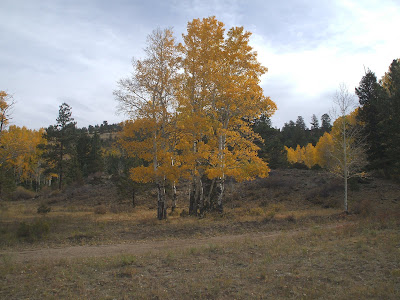
We drove up to the land on Sunday morning. John and I weren't sure if we could locate it positively without Glen, but we did--using the GPS and the map. The aspen were at their peak. The land is rugged, desolate and beautiful. How it sustained many cattle is a mystery to me. I guess that is why there was open range at the time. The elevation is almost 9,000 feet.
Check back for more pictures and details about our trip!

Wednesday, July 9, 2008

The Arrest

Mount Princeton - View from Gas Creek
Ernest Christison was arrested in June of 1883 near St. Elmo with seventy head of cattle that had altered brands. St. Elmo is on Chalk Creek which runs just south of Mount Princeton. He wasn't arrested by lawmen, however, but by a group of South Park cattlemen who took him and others with him on a three-day horse ride to South Park. Ernest and the others were brought before a Justice of Peace and then taken to the Fairplay jail.