Showing posts with label Research Tips. Show all posts

Saturday, January 26, 2013

Colorado Historic Newspapers Collection


One of my FAVORITE  Colorado on-line research sites is the digitized Colorado Historic Newspapers Collection (CHNC) http://www.ColoradoHistoricNewspapers.org There are over 500,000 digitized pages from 163 newspapers, primarily between the years 1859-1923. 

Some of the Central Colorado newspapers I've used are the Buena Vista Herald, Buena Vista Democrat, Colorado Democrat and the Colorado Republican (both Buena Vista), Fairplay Flume, Herald Democrat (Leadville), and Saguache Chronicle. The Rocky Mountain News, Denver Tribune, and the Colorado Weekly Chieftan (Pueblo) have also been beneficial. 


CHNC offers several ways to search the collection. 


BROWSE: You may browse a newspaper by selecting a newspaper and a date from the drop-down menus.


Click on the desired date to view the newspaper:


Click on the article you want to read to view it in a separate window. 


SEARCH: Using the search option, you can search for a name or a place in one newspaper or the entire collection.


Type a name in the "search for" box. To use a first name and last name, click on the AND button between the names. If you use the AND option, It will bring up all of the first and last names, not specific to the combination. Click on the name of the newspaper you wish to search or click on the box beneath the list to "Search in all Publications." Click on "Go" in the top right corner.


Click on the article and it will open up in a new window.
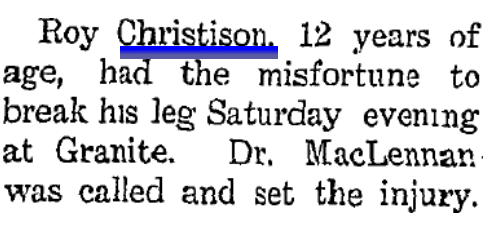


The articles in this post are related to Ernest Christison, my great-great-uncle. He was among the prisoners who broke out of jail in January 1884. And Roy Christison, the unfortunate lad who broke his leg, was his son. 


Newspapers are being added to the collection. I discovered the article about Roy today when I noticed new Buena Vista papers had been added since the last time I researched. 


Saturday, January 5, 2013

Organizing Historical and Genealogical Research


This is all of the research for the book I am writing, with the exception of maps. Notebooks are the backbone of my organizational system. I started out by keeping everything in one notebook, but when the newspaper articles filled the notebook I divided it into two notebooks.

The Newspaper Notebook on the right contains copies of newspaper articles gleaned from hours of staring at the microfilm reader at the Salida Regional Library and at home from the Digitized Colorado Historic Newspaper Collection. Each article is placed in a page protector and arranged in chronological order.


I also have a computer database sorted by date, name, place, event and source. Each article and court event is documented in the database.

The Biographical Notebook contains photographs and genealogical information on all of the people involved in the story. This includes my great-great-uncle, his partner who was lynched, the widow, the cattlemen behind the lynching, the judges, and the lawyers. Census records, land records, cattle brands, obituaries, anything that could be used to glean more information is included in this notebook and organized alphabetically by name.


Because the story involves more than twelve court cases, trying to make sense of the records and organize them was key. I discovered legal-size expanding wallet files in various colors and began using them. I gave each county a color. In the upper-left corner, I wrote the county and the court (county or district) and the case numbers included in the file. The name of the case is in the center - The People vs. Ernest Christison et. al. In the upper-right corner, a short description of the documents in the file helps me locate important documents.


Inside the court case files, I typed up a brief for each case that includes the date, the type of document or court action, and where the copy of the document can be found. Some of the documents are in the research notebook and not in the file.

Notes and other information that didn't necessarily belong in the categories of one of the notebooks are now contained in a clear plastic box. Also early drafts of some chapters are here.

Finally, I have a purple Research Notebook that has the photo of my great-great-uncle Ernest Christison on the front. This is the notebook I take with me when I do research. It is divided into sections.
  • Section 1 is a bibliography of every book, manuscript and court case I've researched.
  • Section 2 contains addresses of archives, museums, and libraries along with operating hours, phone numbers, and a map of how to get there.
  • Section 3 is a print-out of the events from my historical research database.
  • Section 4 contains a page for each research repository and what information I am looking for there. Sometimes I can find information on-line through card catalogs or databases that give me an idea of what to search for there. This also keeps me from looking again for information I've already attempted to find.

Friday, February 10, 2012

Family Search Adds Colorado Statewide Marriage Index


Just in time for Valentines Day, Family Search added the Colorado Statewide Marriage Index 1900-1939 to its battery of databases and indexes this week. The index was a WPA Project in the late 1930's and early 1940's. The cards are arranged by the groom's last name.

Go to http://familysearch.org Scroll down the home page to "Browse By Location" and click on "United States." In the left column of this page, click on "Colorado" and "Colorado, Statewide Marriage Index 1900-1939" will appear. Despite the title, marriage records dated before 1900 are in the index as you can see in my great-grandparents index card above.

This collection isn't indexed. Click "Browse Collection" and pick the name range the surname of the groom falls under. You may browse card by card or you can skip to images using the image number box at the top. The image above is number 1753 under Chavez, Jose Abel - Clayton, Bertram T., Jr.

More information about the original card index and the database can be found on the Western History and Genealogy Blog of the Denver Library.

Have fun and good luck!

Thursday, January 20, 2011

Researching Criminal Court Records


I spent a couple of days in Salida this week researching criminal court records. The ice on the river fascinates me. This picture was taken near Cotapaxi where the sun must not hit the snow long enough to melt it.

In researching the criminal court records for Ernest Christison's cattle rustling book, I am studying court cases involving thirteen different men. It isn't as easy as going to one place to find all of the records. The actual documents from the court cases are housed at the Colorado State Archives in Denver, however, the Record of Court Proceedings is at the Chaffee County Combined Courts in Salida.


When I started researching the story, I started with the Record of Court Proceedings in Salida. I went through the book and found Ernest's court cases, wrote down the numbers and the proceedings, then I visited the State Archives to look at the actual cases. The staff at the archives became well-acquainted with me and the Chaffee County box of court records. I can almost hear their inaudible groan when I ask for that box. It is on the top shelf, needing a ladder to reach it, and it is overflowing with documents. After looking at Ernest's court cases, I started looking for court cases involving other names I'd found in my research. Eventually, I went through every court case in the box, looking for names I recognized and this led me to the thirteen-plus cases I am researching.

Last week I reached the point of writing about the court cases in the January term of 1884. I thought I had everything I needed, however, as I started writing I realized that I had the information from the cases, but not the dates when court proceedings took place. Because this involved the eleven prisoners who escaped from jail, I thought I needed to go back and go through the Record of Court Proceedings again.

Tuesday I spent three hours going through the Court Proceedings, writing down every proceeding that took place--continuances, jury selection, jury verdicts, sentencing, plea bargains, etc. This will really help in writing the trial portion of my book.

Before I went to Salida, several people mentioned they hoped I found something new. I didn't expect to find anything new, but I did! I found a final report from the Grand Jury concerning the deplorable conditions of the county jail at the time of the prison break. The jail was filthy, the sewage pipe blocked for five days, and the prisoners were only receiving two meals a day at 8:00 a.m. and 2:00 p.m. More details to help me write!

TIPS FOR RESEARCHING CRIMINAL RECORDS:

1) Be sure to be looking in the District Court records. Criminal cases will be The People vs. whomever you are looking for.
2) Locate both the Record of Court Proceedings and the trial case documents. Find out if they are located in the same depository or different ones.

3)
Look at cases around the same time as your case. Your criminal may show up in another case where he may be included as "et. al." Or the case may be related to the case you are researching that may clue you in to the bigger story.

4)
Write down everything! Even if it doesn't mean anything to you.


5)
If you know a lawyer, ask him or her about some of the terms or proceedings you don't understand. If not, do an on-line search for terms you aren't familiar with.


6)
Did your criminal go to the state penitentiary? Find out where the prisoner records are kept. In Colorado, the State Archives has the Prisoner Index you can check on-line at this
link. If you find your criminal, then you can visit or request the record which includes the mug shot, description of prisoner, and details of when imprisoned and when released.

Do you have more questions about criminal court records? Leave a comment with your question and I will be happy to answer it if I can!

Sunday, October 10, 2010

The BLM Government Land Office Records Beta Website

Have you always wondered how to find out if your great-great-grandfather really did own a homestead like you've been told in that old family story? Or have you wondered who homesteaded the land you live on now? This information is available on the BLM Government Land Office Records website - one of my FAVORITE links to visit as a genealogist and a historian.

I happened to visit the BLM GLO Records website and discovered they have a Beta release of the 4th generation of their website. It now has map-based searches and I love it! Of course, it makes the workshop I gave at the Colorado Family History Expo obsolete since I went to much trouble explaining how to use Earthpoint and GoogleEarth to locate a homestead on a map, but I am thrilled! Here is the new homepage:


To test the site, I entered the name James Mahan in Chaffee County, Colorado in the search box. According to the story in Under The Angel of Shavano, in 1865 James Mahon traded a yoke of oxen to Wilburn Christison for his homestead on Cottonwood Creek (in the town of Buena Vista today). In the new website, I put a check mark in each box under "map" below Land Description and the land is marked as orange squares in the map below! The only problem I've found that I wish BLM would fix is it won't show allotments of halves, such as the north half of the soutwest quarter. When I check the first box, this message appears, "due to data limitations, we could not map the aliquots or lots of this land description." The map should show two more blocks west of the top block running south of County Road 350 and the west side is adjacent to County Road 353.


You can zoom in on the land to get better detail:


Click on Terrain and you will see that Cottonwood Creek runs through this property:


The Satellite view will show the development in the town of Buena Vista that surrounds this land. This piece of land is under consideration for development at this time, which is sad when you see how pretty it is in the picture below.
Another feature I love in the Beta release is the ability to see who else owned the land patents on the other pieces of land in that section. Click on the Related Documents tab and it shows the list of land patents in that section:


Here is Wilburn Christison's homestead land he traded for a yoke of oxen. That's Mount Princeton in the background. Isn't it beautiful?


Tuesday, March 17, 2009

The Serendipity of Research and Writing

Last weekend my family went to Canon City to see our friend, western singer Barry Ward, perform in concert. Barry is a wonderful musician and singer and we had a great time. A local group, Saddle Strings, opened for Barry. During their performance, the lead singer, Dave, mentioned he lives in Howard and runs Bandera's Bunkhouse, where they have cabins and a motel along the Arkansas River. After the concert, I asked Dave if he had heard the story of the cattle rustlers in the Howard area in the 1880's. Not only had he heard the story, Dave told me he could take me to the gulch where the cattle rustlers (Watkins and Christison) butchered the stolen cattle!

Serendipity: "The faculty or phenomenon of finding valuable or agreeable things not sought for." (Merriam-Webster's Dictionary)

When I told Barry what had happened, he said, "You were meant to be here tonight!" I e-mailed my writer friend,
Dianne Butts, about it when I got home and wrote, "Can you believe it?" She replied, "Yes, I can believe you found more people to take you further on your book-writing journey. You know why? Because stuff like that ALWAYS happens to you!!! THAT'S what I can't believe!"

For those of you who follow Colorado Reflections, you know this to be true. More often than not, the great finds and contacts I've made have not been diligently searched for, but have been surprises I found when least expecting them.

A few examples:


Photograph of Wilburn and Elizabeth Christison

You Never Know - Discovering a cousin who worked in the same library district as I do

Lynn Monroy, Graphologist - Coming into contact with a woman who does handwriting analysis

Black Mountain - Contacted by a Mulock Descendant

Writing a book is a journey and one that I am enjoying moment by moment. I am reminded of what author
Jane Kirkpatrick told me: "The story wants to be told and will find ways to reveal itself to you." Sometimes I want to rush to finish the book, but I know it will be done at the proper time as the story makes itself known to me.

Thursday, January 22, 2009

Verify Research Sources

Last year, I found an 1859 Post Office Directory at the Making of America website sponsored by the University of Michigan. Making of America has an incredible collection of scanned and searchable books. In the 1859 directory, I found the Cash Creek post office listed. This fascinated me because the histories I've read about Cash Creek indicate the mining camp started in 1860.

Well, I used the 1859 date in my proposal for the Pikes Peak Regional History Symposium. I thought I'd better check it again and kept looking in Google Books for the directory and it didn't show up. This morning I remembered it might have been in Making of America and, sure enough, there was the directory with Cash Creek listed. Looking closer at the entry I saw "Cash Creek, Lake, Colo." This time, the Lake County and Colorado caught my eye. Colorado was a part of Kansas Territory in 1859. I went to the title page and found that the Post Office Directory was published in 1870. Ugh.

I'm planning a trip to the
Rocky Mountain Regional Office of the National Archives. They have the microfilm of the reports of site locations for post offices. There is no guarantee that the papers for the Cash Creek post office are included (some early post offices aren't), but it is the next step for my research.


Research Tip of the Day: When searching on-line books, always look at the title page for source information and PRINT it!

Friday, December 5, 2008

Researching Chaffee County in the 1870 Census

Until 1879, Chaffee County was the southern part of Lake County. The 1860 and 1870 census will show people who lived in what is now Chaffee County in the Lake County census. The Lake County census includes Oro City, Centreville, and Granite. HeritageQuest also includes Fairplay in the Lake County census possibly because William Beery conducted the census for both counties and the towns are not in order according to county in his census pages.

Usually, the census taker would enumerate the households in a settlement or post office, then start a new record for the next post office. But William Beery didn't seem to take this approach to gathering his statistics. He started in Oro City, which is now Leadville, and worked his way south.


This became clear to me when I found my great-great-grandfather, Wilburn Christison, in the Oro City census as Wilburn Christie. It seemed funny to me that he was farming in the Leadville area amongst all of the miners. Then I saw the next name was James Woodard, who farmed near Trout Creek at the time. So, Wilburn probably lived north of Woodard in the Trout Creek area at this time. You will notice Henry A.W. Tabor in Oro City, listed on the page before Wilburn Christie.

Continuing south in the Oro City census - Other names that help locate where the people were living include:
Charles Nachtrieb - Owned the flour mill at Nathrop, the town named for him
Thomas Cameron - Adobe Park, near today's Salida
John Burnett - Poncha Springs


The Centreville census shows people living in the Brown's Creek and Gas Creek areas (the people involved in the Lake County War). June Shaputis wrote a book called
Where The Bodies Are that tells about the people involved in the Lake County War and where they lived. It's a valuable resource.


Granite is also in Chaffee County now.

I hope this helps solve some of your Chaffee County 1870 census problems. Leave a comment if you have any questions or you can e-mail me directly by clicking on my photo in the sidebar and finding my e-mail under my profile.


Friday, July 13, 2007

Fairplay Trip

I drove up to Fairplay Wednesday. The wildflowers on Wilkerson pass were gorgeous! First stop, the Park County Library, which is in the old courthouse. The Park County Local History Archives is in a tiny room in the basement. I met Jane, the archivist, who pulled out folders and books for me to look at. From Jane, I learned that many of the Park County court records are in the State Archives. I also met Linda, the historic preservation coordinator. Jane and Linda suggested I call Jerry, a Fairplay history buff.

Yesterday I called Jerry, who was a wealth of information. Jerry even knew about Wilburn Christison! We had a great conversation. And now I have an expert I can call and verify facts about Fairplay.

After I visited the archives, I went to the County Clerk's office. Although I've done quite a bit of research into mining records and land records, Wilburn's paper trail in Fairplay is rather confusing to me. Partly because I'm not sure what are Wilburn's personal transactions and what are transactions where he is representing someone as their attorney. After spending an hour looking at deeds and not really understanding what they meant, I gave up and went home completely drained and wiped out.

That night I called Joy, a friend who works in the Elbert County courthouse, and asked a few questions. Joy patiently answered my questions and I finally blurted out, "Joy, I need you to go to Fairplay with me so I know what I'm looking at." And she agreed! What a trooper! She spends her working days looking at deeds and is willling to spend her day off in another courthouse investigating deeds. This will be a tremendous help.

This trip to Fairplay is a reminder that I'm not in this alone. So many times I ferret out information on my own, the independent westerner. But I'm not alone. Each piece of information I find is the result of someone else's work. And I discern the best understanding of the information when I'm able to talk to someone who has expert knowlege on the subject. I so appreciate the people who have told me I can call them or write them with questions. Thank you!

Friday, December 15, 2006

Lake County and Chaffee County

One of the things I need to mention about the Lake County War (read November 29 post) is that it took place in what is now Chaffee County. In 1879, the southern part of Lake County from Granite south to Salida became Chaffee County. Today, some of the records for old Lake County are in Salida.

Friday, December 8, 2006

Research Notebook and Logs

My friend, Tanya, asked about my historical research notebook. I have a 3” notebook crammed full of everything I’ve found on the Christison family. All of the pages are in page protectors. It is divided by generations and numbered.

This fall I realized I need to keep research logs so I have a record of what books and records I’ve examined and what I still need to look at. I started a file of research logs on my computer. I’ve used the name “book” for files for the book. So the research logs are a file named “book.research logs.” Then I set up folders for each town or city where I would be doing research -- “book.research logs.Denver.” The research logs are titled by town and place of research -- Denver, State Archives. The logs have the information I’m looking for with a box to check them off when I’ve completed it.

As I write and research, I’m constantly going to the logs and adding something I need to check. Then I print off the logs I need for the place I’m going and hopefully, be able to do some productive research!

Tuesday, December 5, 2006

Expect The Unexpected in Research Trips

I’m gearing up for some research trips. I’ve got my research logs filled out; ready to move in and mine out the smallest details and perhaps, the greatest nuggets!

Research trips don’t always go the way I plan. I hit the road knowing exactly what town, library, courthouse, or museum I will be perusing that day. But a couple of years ago, on a historical research trip to Fairplay, I learned to expect the unexpected.

I drove to Fairplay from my home, arriving at the library around 10:00. The Fairplay Library is in the old Park County Courthouse. This is the very courthouse that my great-great-grandfather Wilburn Christison presided over probate court cases and practiced law. It is always awe-inspiring for me to walk through the doors of this tiny two-story building. That day, I started looking at books.

I hadn’t been there more than 20-30 minutes when I squatted down to look at a book and heard and felt, “RRRIIIIPPPP!” I now had a nice long tear in the rear end of my pants. I was mortified! I looked around to see if anyone had noticed, but nobody else was in the room. My mind started whirling--where could I get a pair of pants in Fairplay? I was pretty sure there wasn’t a store that carried pants. So, I could either go back to Colorado Springs or Denver and give up on my research trip, or I could go to Buena Vista where I figured there was chance of finding a store that sold pants.

I drove to Buena Vista, found an Alco and left feeling much more confident in my new pair of jeans. I decided to drive north to Granite and Leadville, an area I’d never been to. I found the courthouse in Leadville and started looking at old Lake County records, discovering mining claims Wilburn Christison had filed on and mining partnerships. It opened a whole new area of research. So, even when you rip out your pants and have to change your plans and drive much farther than you expected, you never know what new doors will open!

Sunday, November 26, 2006

Colorado Historic Newspaper Collection

Several months ago I learned about the Colorado Historic Newspaper Collection: http://www.coloradohistoricnewspapers.org

This project is a collaborative effort by the Colorado State Library, the Colorado State Historical Society and the Collaborative Digitization Program. At this time, 86 Colorado newspapers published between 1859-1928 are available for viewing on-line. This collection is searchable by dates and keywords. It is a goldmine for any researcher of family history in Colorado or of Colorado history.

Imagine how thrilled I was to learn that the Fairplay Flume was one of the newspapers on-line! So now, instead of sitting in the Fairplay library looking through microfilm, I can sit in the comfort of my own home and spend hours staring at my computer screen. Now, if I only had high-speed Internet…
I’ve found many other snippets of information in other newspapers on the site, too, like the Rocky Mountain News, the Denver Daily Times, the Pueblo Chieftain. It reminds me to leave no stone unturned in the search for family history.